You’ve heard it at some point. Maybe from a well-meaning relative, maybe from a fitness influencer, maybe from a nutrition class: plant proteins are “incomplete,” and if you don’t carefully combine your rice and beans at every meal, you’ll come up short on amino acids.
It’s one of the most persistent myths in nutrition. It’s also wrong — and it has been known to be wrong for about forty years.
Let’s take it apart, because understanding why it’s wrong makes eating plant-based a whole lot less stressful.
First, what “complete” actually means
Protein is made of amino acids. There are 20 of them, and 9 are “essential,” meaning your body can’t manufacture them — you have to eat them. A food is labeled a “complete” protein when it contains all 9 essential amino acids in roughly the proportions humans need.
Animal foods generally hit that mark. Many individual plant foods are lower in one or two essential amino acids — grains tend to run low in lysine, legumes tend to run low in methionine. That single fact is the entire basis of the “incomplete” label.
Here’s the part that got lost: “lower in” is not “missing.” Every plant food contains all 9 essential amino acids. They’re built from the same 20 amino acids your body uses — the genetic code is universal. A lentil isn’t missing methionine; it just carries relatively less of it. That distinction changes everything.
Where the myth came from
The idea of “protein combining” was popularized by a 1971 book called Diet for a Small Planet by Frances Moore Lappé. She argued that because plant foods were lower in certain amino acids, vegetarians needed to pair complementary foods — beans with grains, for instance — within the same meal to build a “complete” protein.
It was a reasonable-sounding idea based on the science of the time (some of which traced back to old studies on rats, whose protein needs are not ours). But here’s the part nobody quotes: Lappé herself retracted it. In later editions of her own book, she walked the claim back, acknowledging that as long as you eat enough calories from a variety of plant foods, protein takes care of itself. The correction never spread as fast as the original myth.
Why combining at every meal is unnecessary
The critical thing modern nutrition understands that 1971 didn’t: your body maintains a pool of free amino acids. When you digest protein, the amino acids don’t get used up in that exact meal and vanish. They circulate, and your liver holds a reserve. Amino acids from your lunch are still available to combine with amino acids from your dinner.
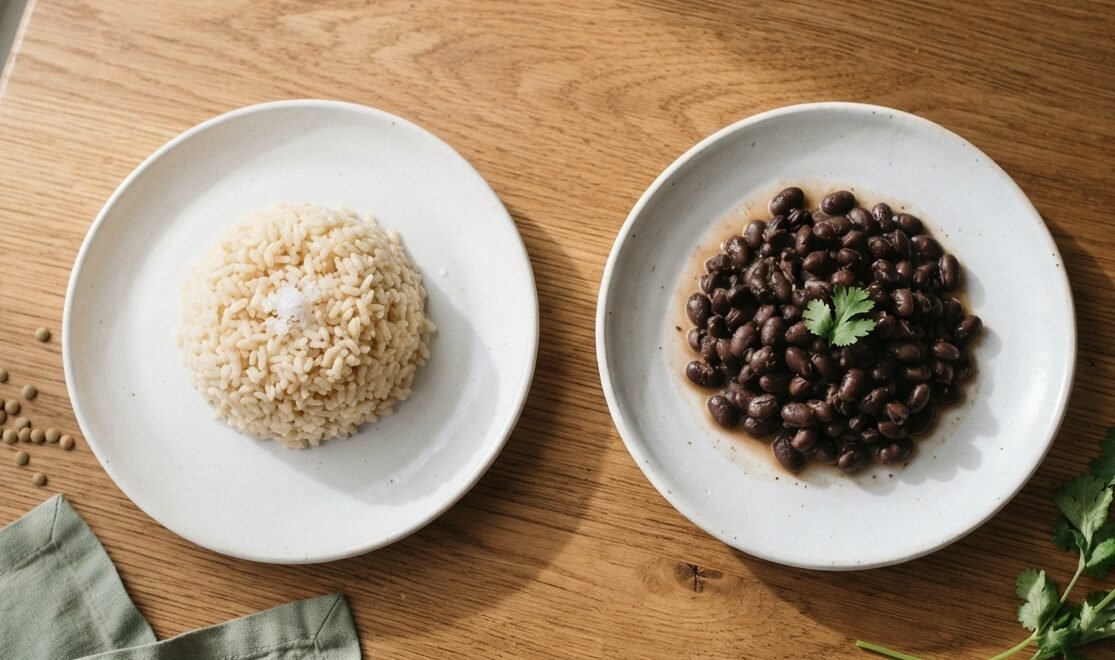
So the “you must eat rice and beans together” rule collapses. Eat beans at noon and rice at six and your body assembles what it needs from the pool. Over the course of a day, a varied plant-based diet delivers the full amino acid profile without any conscious pairing on your part.
The Academy of Nutrition and Dietetics — the largest body of registered dietitians in the U.S. — has said for years that plant proteins eaten over the course of a day supply all the essential amino acids a healthy adult needs. Even organizations that were once skeptical, like the American Heart Association, have updated their language to acknowledge that plant proteins can provide all the essential amino acids.
The plant foods that are “complete” anyway
Even if you wanted to ignore the amino acid pool entirely, plenty of single plant foods already contain all 9 essential amino acids in good proportion:
- Soy — tofu, tempeh, edamame, soy milk
- Quinoa — technically a seed, cooks like a grain
- Buckwheat — despite the name, not wheat at all
- Hemp seeds — easy to sprinkle on almost anything
- Chia seeds and pistachios — round out the list
But the honest takeaway is that you don’t need to chase these. They’re a bonus, not a requirement.
What actually matters
If protein combining is a non-issue, what should you actually pay attention to? Two things:
- Eat enough total calories. The most common way plant-based eaters fall short on protein isn’t amino acid balance — it’s simply not eating enough food overall.
- Eat a variety of protein-dense plants. Legumes, soy, whole grains, nuts, and seeds across the day. Variety handles the amino acid math automatically.
That’s genuinely it. No spreadsheet, no meal-by-meal pairing, no anxiety about whether your lunch was “complete.”
One honest caveat
Protein combining being a myth doesn’t mean protein needs are trivial. Certain groups — older adults fighting age-related muscle loss, serious strength athletes, and anyone eating a very low-calorie or very low-variety diet — should be more deliberate about getting adequate protein. Plant foods can absolutely meet those higher needs; it just takes a bit more intention. If you’re in one of those groups and unsure, a registered dietitian is worth a conversation.
For everyone else eating a normal, varied, calorie-sufficient plant-based diet? The rice and beans can hang out on separate plates. Your liver’s got it handled.