The new dietary guidelines landed in January, and they came with a lot of headlines.
Eat more protein. Protein at every meal. Full-fat dairy is back. Highly processed foods are out.
Depending on where you get your news, it was either a long-overdue reset or a step backward.
I’m not here for the politics. I’m interested in what it means for your plate, especially if that plate is mostly plants.
What actually changed (the short version)
The 2025–2030 Dietary Guidelines for Americans were released on January 7, 2026 by the Department of Health and Human Services and the USDA. They’re updated every five years, and they shape programs like school meals and military food service.
Here are the changes that matter most for this conversation:
- A higher protein goal of 1.2 to 1.6 grams per kilogram of body weight per day.
- Protein foods prioritized at every meal.
- Full-fat dairy with no added sugars, for people who eat dairy.
- Limits on highly processed foods.
- A saturated fat cap of no more than 10% of daily calories, carried over from before.
The guidelines recommend a variety of protein foods. That includes animal sources like eggs, poultry, seafood, and red meat, plus plant sources like beans, peas, lentils, nuts, seeds, and soy.
Why the new dietary guidelines protein goal is a big deal
For years, the most quoted protein number was the RDA of 0.8 grams per kilogram. That’s still the RDA today.
So the jump is significant. For a 70 kg (154 lb) person, 0.8 g/kg is about 56 grams a day. The new range works out to roughly 84 to 112 grams.
Supporters say that’s the point. FDA Commissioner Marty Makary argued that the old protein guidance was built to prevent deficiency, while the new targets aim to help people thrive.
Why the new dietary guidelines are being debated
Not everyone is on board.
The Vegetarian Resource Group pointed out that the RDA for protein hasn’t changed, which raises a fair question about what the higher goal is based on.
The Physicians Committee for Responsible Medicine, a plant-based advocacy group, argues that most Americans already get enough protein. Their concern is that a national eat-more-protein message will turn into more meat and dairy, which could work against the saturated fat limit.
There’s also a notable shift from the science advisory committee’s report. That committee had recommended prioritizing plant proteins like beans, peas, and lentils. The final guidelines took a different approach and recommend both, with animal sources listed first.
My take? Both sides have a point. Protein matters, especially as we get older and more active. But where your protein comes from matters too.
The good news for plant-based eaters
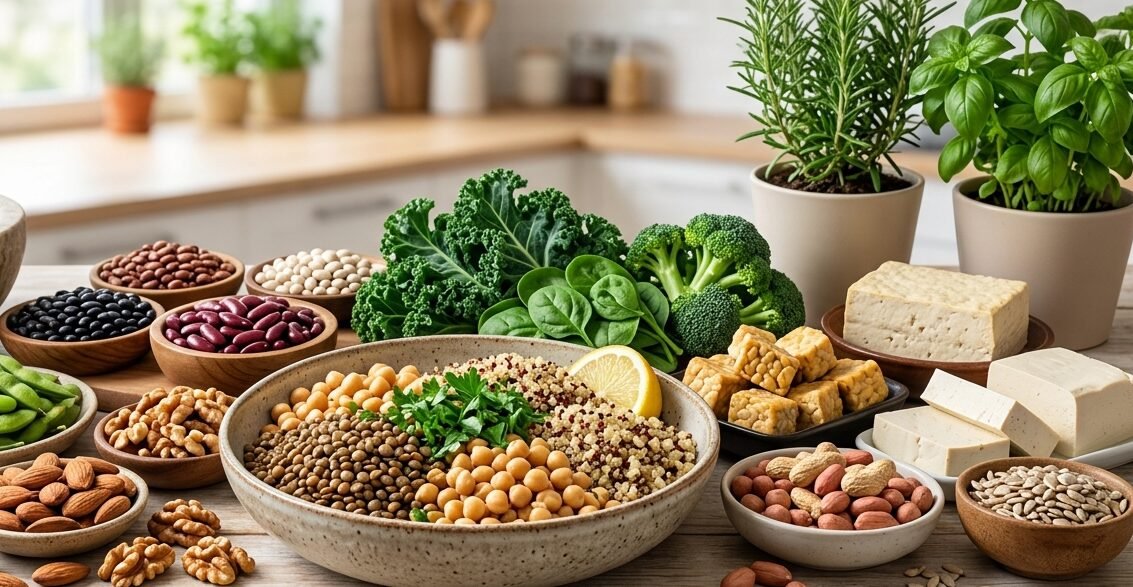
Here’s what most headlines missed: you can hit the new dietary guidelines protein target on plants.
Beans, peas, lentils, soy, nuts, and seeds are all right there in the protein foods list. On top of that, plant proteins bring fiber with them, and most Americans don’t get nearly enough fiber.
In my protein guide, an ordinary day of oatmeal, a chickpea grain bowl, and a tofu stir-fry hit roughly 90 grams without any protein powder. That already lands inside the new range for a lot of people.
Want to reach the upper end? Add tempeh or seitan, swap in soy milk, and keep edamame around for snacks.
And if you’re worried plant protein is second-rate, it isn’t. In a 2021 study, vegans built muscle just as well as omnivores during 12 weeks of strength training when their protein was matched.
How to put the new dietary guidelines into practice
- Anchor every meal with protein. Beans, lentils, tofu, tempeh, edamame, or seitan all count.
- Start at 1.2 g/kg. Aim higher if you strength train seriously or you’re older and protecting muscle.
- Choose minimally processed plant proteins most of the time. The push against highly processed food applies to plant-based junk food too.
- Don’t chase a number at the expense of everything else. Vegetables, fruit, and whole grains still matter.
One honest caveat
The new dietary guidelines are written for the whole population, not for you specifically. Kids, older adults, athletes, and people with kidney disease all have different needs.
Also, I’ve summarized a long document and a big debate in a short post. If you have a medical condition, a registered dietitian will be a far better guide than any national chart. And the official guidelines are worth reading for yourself.
The bottom line
The new dietary guidelines turned protein into a national conversation. Honestly, that’s not a bad thing.
Eat enough protein. Get plenty of it from plants. And don’t let anyone tell you a plate of lentils and tofu can’t keep up.
Be Good And Do The Right Thing.
References
- Morrison Foerster. New U.S. Dietary Guidelines Released: What You Need to Know. January 8, 2026.
- Cooney E, Cueto I, Todd S. Dietary guidelines declare war on processed foods and sugar, encourage more protein and dairy. STAT. January 7, 2026.
- The Vegetarian Resource Group. 2025–2030 Dietary Guidelines for Americans Released. January 22, 2026.
- Physicians Committee for Responsible Medicine. 2025–2030 Dietary Guidelines for Americans: A Mixed Bag.
- Hevia-Larraín V, et al. High-protein plant-based diet versus a protein-matched omnivorous diet to support resistance training adaptations. Sports Med. 2021;51(6):1317–1330.