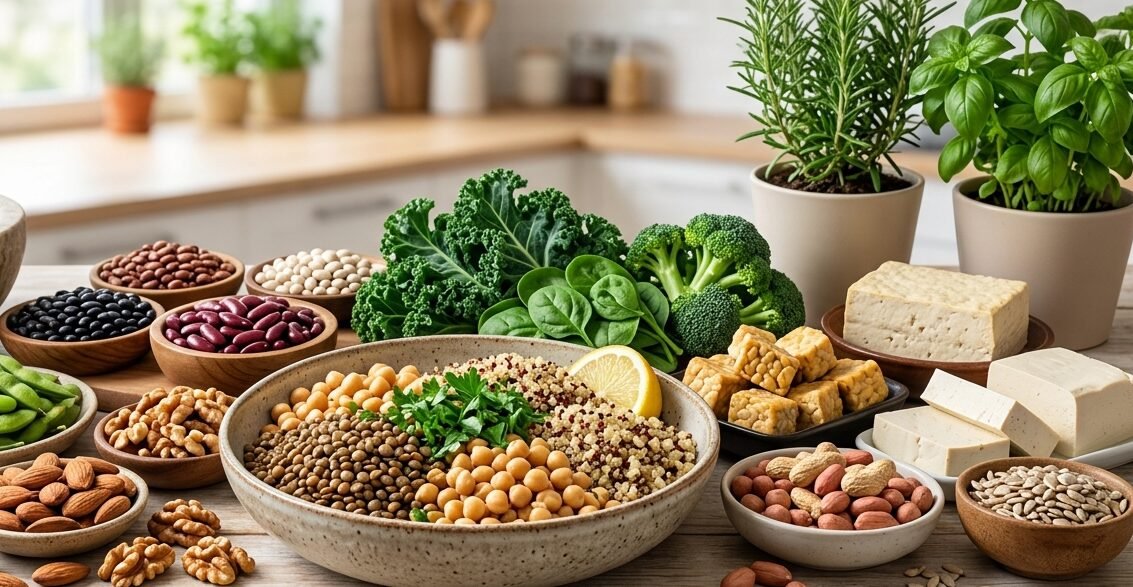
Creatine for vegans is one of those topics that makes plant-based people a little uneasy.
It sounds like something sold in a giant tub next to a bottle of neon pre-workout.
I get it. I’ve been lifting since I was 18, and I’ve watched a lot of supplements come and go.
But creatine is different. It’s one of the most studied supplements on the planet. And if you don’t eat meat, the research suggests it may be worth a closer look.
So let’s look at what creatine is, what the studies actually show, and where the hype gets ahead of the science.
What creatine actually is (and why vegans have less)
Creatine is a compound your muscles use to recycle energy quickly. It matters most for short, hard efforts like a heavy lift, a sprint, or a surge up a hill.
Your body makes some creatine on its own. The rest usually comes from food, and that food is almost entirely meat, fish, and other animal products.
So it’s no surprise that muscle creatine levels are lower in vegetarians. Vegans get essentially none from their diet, so they rely on what the body makes.
That isn’t a deficiency in the medical sense. However, it does mean there’s more room to fill the tank.
What the research says about creatine for vegans
The best summary I found is a 2020 systematic review by Kaviani, Shaw, and Chilibeck. They pulled together nine studies on creatine supplementation in vegetarians.
Here’s what they found:
- Muscle creatine went up, often to levels higher than those seen in omnivores.
- Lean tissue mass, muscular strength, and muscular endurance improved.
- Memory and intelligence scores improved in some of the studies.
That’s a pretty strong list for a cheap white powder.
But there’s a catch. When studies compared vegetarians directly against omnivores, the results were mixed on whether vegetarians got a bigger performance boost. In other words, plant-based athletes are likely to benefit, but the idea that they benefit more is still an open question.
The brain piece (this is the surprising part)
Creatine isn’t just a muscle story.
In a 2011 study in the British Journal of Nutrition, researchers gave creatine to young women who either did or didn’t eat meat. Memory improved in the vegetarians, but not in the meat eaters.
An earlier 2003 trial also found that six weeks of creatine improved working memory in a group of vegetarians and vegans.
Now for the honest part. Unlike muscle, brain creatine levels in vegetarians don’t appear to be lower than in omnivores. The 2020 review also found that supplementation didn’t change brain phosphocreatine. So the benefit showed up, but the reason why isn’t clear yet.
I find that fascinating. Still, I wouldn’t start taking creatine for your brain based on a couple of small studies.
Is creatine vegan? (usually, yes)
Here’s some good news about creatine for vegans. Creatine monohydrate, the most common and most researched form, is generally made synthetically rather than from animal products.
Check two things, though. First, capsules can contain gelatin, so choose a powder or a vegan-labeled capsule. Second, look for a third-party testing seal like NSF Certified for Sport or Informed Sport, because supplements aren’t approved by the FDA before they’re sold.
How much creatine for vegans? (the dosing basics)
The International Society of Sports Nutrition (ISSN) position stand is the go-to reference here. The usual maintenance dose is 3 to 5 grams a day.
You’ll also see a loading phase of about 20 grams a day, split into smaller doses, for five to seven days. That fills your muscles faster, but it’s optional. A steady daily dose gets you to the same place in about a month.
The ISSN also notes that even a habitual intake of around 3 grams a day may offer health benefits throughout life. For most people, the most important thing is simply consistency.
Is creatine for vegans safe?
According to the ISSN, there’s no compelling evidence that creatine monohydrate harms healthy people, even at doses up to 30 grams a day for five years.
A few practical notes. Creatine can raise creatinine on a blood test, which is a common kidney marker. That doesn’t mean your kidneys are damaged, but tell your doctor you take it so your labs aren’t misread. If you already have kidney disease, talk to your doctor before you start.
You may also gain a little water weight at first, especially with a loading phase. That’s water stored in muscle, not fat, and it’s true of creatine for vegans and meat eaters alike.
Does creatine help endurance athletes?
This is the question I care about most right now, since I’m working toward an Ironman.
Creatine’s strongest evidence is for short, high-intensity efforts. It isn’t an aerobic fuel, and it won’t make a six-hour bike ride feel easier.
That said, endurance training in your 40s isn’t only about cardio. As I wrote in Week 0, strength and recovery matter a lot more at this age. Creatine supports the strength side, and that’s the real reason I’d consider it.
One honest caveat
The research on creatine in vegetarians and vegans is promising, but it’s built on small studies. Nine studies isn’t a huge body of evidence, and many had only a few dozen participants.
It’s also worth knowing that the lead author of the ISSN position stand disclosed research funding and consulting ties to supplement companies. That doesn’t make the conclusions wrong, but you deserve to know it.
Finally, creatine doesn’t replace the basics. If you’re not eating enough protein, sleeping well, and training consistently, a supplement won’t fix it.
The bottom line
The case for creatine for vegans is pretty simple. If you’re plant-based and you lift, sprint, or train hard, it’s one of the few supplements with real evidence behind it, and it fills a gap your diet can’t.
Keep it simple: 3 to 5 grams of creatine monohydrate a day, a third-party tested product, and a heads-up to your doctor.
And if you want the protein side dialed in too, start with my guide on how to hit your protein on a plant-based diet.
Be Good And Do The Right Thing.
References
- Kaviani M, Shaw K, Chilibeck PD. Benefits of creatine supplementation for vegetarians compared to omnivorous athletes: a systematic review. Int J Environ Res Public Health. 2020;17(9):3041.
- Benton D, Donohoe R. The influence of creatine supplementation on the cognitive functioning of vegetarians and omnivores. Br J Nutr. 2011;105(7):1100–1105.
- Rae C, Digney AL, McEwan SR, Bates TC. Oral creatine monohydrate supplementation improves brain performance: a double-blind, placebo-controlled, cross-over trial. Proc Biol Sci. 2003;270:2147–2150.
- Kreider RB, et al. International Society of Sports Nutrition position stand: safety and efficacy of creatine supplementation in exercise, sport, and medicine. J Int Soc Sports Nutr. 2017;14:18.